Categories
For nonprofit leaders and social innovators

Recap > AFP Vancouver: Leveraging Social Media to Facilitate Fundraising Efforts

AFP Vancouver’s monthly breakfast meeting brought together four panelists (contact information below) experienced in social media, mobile giving, and other digital communications strategies.

While the questions asked of the panel might suggest otherwise, a general theme of the responses from the panel was “social media is just one part of a more complete fundraising and engagement strategy”. Here is a summary of the responses of the panelists on tips for using social media and mobile giving as a fundraising tool. (Notes in brackets are my own additions).

Why use social media as a fundraising tool?

  • Integrated into offline efforts and personal connections; it’s a piece of a whole
  • It’s only a tool; there needs to be a strategy behind it
  • Provides opportunities to listen to and engage with a community of supporters
  • Help supporters share your message with their networks
  • Get your org into the hands of as many as possible
  • Get more earned media
  • Get more volunteers
  • Use it for calls to action

What are tangible actions on Facebook to raise money?

Before you start…

  • “Dig your well before you need it” – if you are starting now and want to raise money now, you’re too late.
  • Need an engagement plan first.
  • Website should be the centre of any online campaign; all online outlets should be connected to each other.
  • Messages should be consistent across online platforms.
  • Once people click through to the website, they should NOT be directed to your home page. It should be easy for them – clear donation page, easy payment options, email follow up written well. Ensure a good user experience.

How to amp up your Facebook success

  • It’s possible to create a custom landing page for Facebook Pages. Landing pages results in higher page “likes”. (FBML was referred to, but this is now out of date – landing pages are now built using frames. Check out this post by Beth Kanter for more information on Facebook landing pages).
  • Multiple touch points (i.e. supporters follow you by email newsletter, texts, Facebook) leads to increase giving. Need to know donors’ communication preferences.
  • Online = smaller gifts because these donors are often on a lower rung on the ladder of engagement.

Specific tips

  • Need to share a variety of content and not too much. Max 3/day. (Check out Dan Zarrella for great stats on how to get the most from your social media efforts. He found that once every two days is best.)
  • Create urgency. Make specific asks.
  • If you show up only to make asks, you may get huge (and public) backlash.
  • Reply to comments. Use people’s names. Click through to their profiles to get to know them better (if their profiles are public).
  • Share successes and how money is being used.
  • Need to have a visibility action plan – be checking account at least 5 days/week, 5 min- 1 hr/day. Timing depends on when your supporters are online.

Other thoughts

What are tangible actions on Twitter to raise money?

  • Twitter is a community. Many people interact/influence exclusively on Twitter.

Specific tips

  • Tell. Ask. Share. Engage. Monitor.
  • Rebroadcast messages in different ways. Talk at different times of the day, depending on when your demographic might be online.
  • Have fun. Be authentic.
  • Keep messages to <120 or even <100 characters so that people can easily retweet you without having to shrink your message.
  • Use hashtags (eg #elxn41 was used for the recent federal election). Start a conversation, make sure your supporters know to use it, then follow the hashtag to monitor the conversation.
  • Do keyword research to monitor conversations. Use word that your audience would use, and not necessarily the jargon you use.
  • Use Hootsuite as a tool to monitor all your social media accounts (ie also Facebook too). You can post to multiple accounts and schedule tweets. “Cook once and eat 3 times.”

General uses

  • Use it to connect with influencers. (They don’t need to be following you). Journalists are all over Twitter. Find ones that have a concern for the issue/topic you are wanting to raise.
  • Use it to make your superfans super happy by highlighting them/their work or sharing prizes.
  • Drive traffic to mobile giving campaigns – this has been very effective in disaster response fundraising.Twitter and mobile giving go well together because people are often using Twitter on their phones already.
  • Great for listening for breaking news that might be relevant to your work and that you might be able to piggyback onto.

And mobile giving?

How it works

  1. There is no text messaging fee to the user for donation texts. These are absorbed by wireless carriers.
  2. Carriers charge for the donation (currently now only $5 or $10). Carriers pass on $ to Mobile Giving Foundation Canada (MGFC, a registered charity), which passes on money to the charity.
  3. Only charities are currently licensed to do this. Must fill out application with MGFC.
  4. Charity works with one of the recommended service providers to arrange the text choice (eg text HAITI to 1234567) and do the techie stuff. (Note: This is where the cost to the charity comes from – paying the service provider. This is NOT the wireless carrier, but a company that arranges mobile giving).
  5. When people make a text, the get a reply asking them to confirm their donation by replying “Yes”, after which a “Thank You” text is received. At this point charities can also arrange with the service provider to conclude with a “Reply to sign up to receive further texts from Charity XYZ”. Any further texts to/from the charity will result in standard text message rates being applied to the individual.
  6. Individuals can get tax receipts online via a code they request by text. Receipts are given by MGF, not the charity. Donor information (ie phone number, account name) is not currently shared with the charity (unless the “reply to sign up for more” is completed above).

Why mobile giving is important

  • It reaches a new demographic. They often have never given before. Low barrier. A credit card or cheque isn’t necessary.

Challenges with mobile giving

  • Limited amounts to give (only $5 or $10 currently). Information isn’t shared with charities. Costs charged by service providers are prohibitive for smaller campaigns. MGFC is looking to address some of these.
  • Because of these issues, mobile might remain limited to mostly disaster response giving. Another technology might leapfrog into prominence by the time these issues are sorted out.
  • (One current possibility in print is a combination of QR codes with websites designed for phones.)

Final Thoughts

If all this seems overwhelming, I suggest listening first. I recently set up and gave personal training on a “digital listening” plan with a client to get them started with social media. By following some of your personal favourite nonprofit organizations through Facebook, Twitter, their blogs and e-newsletter, you can quickly get a sense of how others use it, and what seems to be working.

Panelists’ information

Dave.ca Communications (Dave Teixeira)
www.dave.ca
@davedotca

Raised Eyebrow (Lauren Bacon)
www.raisedeyebrow.com
@laurenbacon

Beachcomber Communications (Angela Crocker)
www.beachcombercommunications.com
@angelacrocker

Mobile Giving Foundation (Katherine Winchester)
www.mobilegiving.ca
@mgfcanada

Categories
For nonprofit leaders and social innovators

Upcoming events: 4/26 Social change film school open house; 5/03 Change Through Food Systems

Two interesting events coming up for people that like to make important connections for social change. I can’t make it to the first, but hope to find out more about their program and what they can offer the nonprofit sector. The second I help organize, so maybe see you there? We’re already registered to capacity, but you can add yourself to the wait list.

Pull Focus Open House

Pull Focus Open House
April 26, 2011 | 7pm

In the spirit of grassroots social change, Pull Focus Film School brings together emerging filmmakers, activists, non-profit practitioners, and media innovators in an environment that encourages conversation, collaboration and creative engagement in social change.

The goal of Pull Focus is to empower students to tell stories they care about while raising awareness about many of the amazing and ambitious efforts that are currently being undertaken within the non-profit community.

Pull Focus celebrates its spring program with an Open House on April 26th at 306 Abbott Street in Gastown. Come experience the ‘social change’ spirit, in tandem with the exciting evolution of the local mediascape.


——

Change Through Food Systems

Change Through Food Systems
May 3, 2011 | 6pm

From producer to intermediaries to consumers, how can positive change happen through our food systems? We all play a part – let’s talk it out!

Join us as three unique individuals spark a conversation about food systems and have your turn to make connections to new ideas, people, and passions.

Moderator: Anthony Nicalo @tonynicolo – chef; entrepreneur; building first global map of local food @foodtree

Speakers:

  • Arzeena Hamir @arzeena – agrologist; coordinator for the Richmond Food Security Society; engaging diverse communities in the food security conversation
  • Herb Barbolet – food activist; researcher; author
  • Mijune Pak @followmefoodie – food blogger at Follow Me Foodie; facilitating producers and consumers in conscious engagement with food
Categories
For nonprofit leaders and social innovators

3 reasons why I’m a National Volunteer Week skeptic

So this week coming to an end is National Volunteer Week.

My reaction? Meh.

This is why.

Volunteers need constant engagement

If organizations are drawing public (or private) attention to their volunteers and thanking them this week only, I bet they are having a hard time retaining volunteers. It’s like a romantic Valentines Day dinner when your partner is an ass the rest of the year. Doesn’t mean much.

Volunteerism doesn’t need awareness-raising

Volunteerism as a concept does not need promotion. Volunteering for specific organizations might. But drawing volunteers to an organization involves more than good promotion. It requires an organizational culture that is attuned to the changes in the expectations and interests of volunteers. I’ve had the opportunity to speak to outstanding people who are meaningfully engaging volunteers through their work – and they have few problems recruiting volunteers, and rarely need to promote.

Volunteer agencies are bad at PR

Yes, #NWV11 has had some traction on Twitter. But really, as someone who is fairly embedded within the nonprofit and volunteerism culture in Vancouver, BC and Canada, I am often surprised how rarely campaigns promoting a spirit of volunteerism reach me. I’m not saying it’s easy – I had the job of promoting engaged citizenship at SFU and it’s was a slow and tough slog. It’s hard when your target market is broad and diffuse. But these organizations are often preaching to the converted, and even then only a very small circle of the converted.

Instead…

Instead, organizations tasked with the promotion of volunteerism should focus on those doing the volunteer engagement. How can you help them succeed in promoting a spirit of meaningful volunteerism within their organizations?

Let’s shift to a place where citizens are clamoring at our doors because we all are offering engaging opportunities that address the realities of the present. Volunteerism isn’t changing. It has already changed.

Categories
For nonprofit leaders and social innovators

Incomplete Thought #3: Which comes first: next generation voting, or civility in politics?

Next generation voter turnout rates are bad in Canada at all level of elections – student government to federal government.

I think this is for a combination of many reasons. Some logistical: it’s a bit of a pain for university students who live and/or spend the majority of their time NOT in their home riding. Some apathetical: there doesn’t seem to be a direct impact on their lives, and their one vote wouldn’t change anything. Some related to frustration: being so disgusted with the decorum of politics that voting for anyone makes their skin crawl.

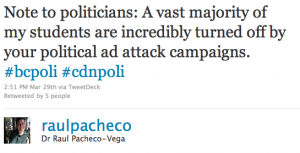
Note to politicians

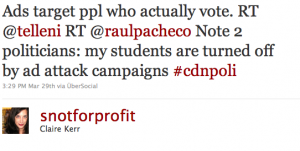
Ads target

Because youth don’t come out to vote like other age groups, the youth vote isn’t targeted (and if it is, it would seem that all the next generation cares about is marijuana and tuition). Sure it might be pandered too, but not properly courted. I used to argue that in order to attract the youth vote, politicians needed to make politics more civil, more engaging. But now, I think I’m with Rick Mercer. Youth need to turnout to vote first. Eventually, the pandering will follow.

It is the conventional wisdom of all political parties that young people will not vote. And the parties, they like it that way.

So please, if you are between the age of 18 and 25, and you want to scare the hell out of the people that run this country, this time around, do the unexpected. Take 20 minutes out of your day and do what young people all over the world are dying to do. Vote.


So which should come first? Young voters turning out? Or civil, engaging, relevant politics? Who owes what to whom?

Discuss.

The Incomplete Thought Series is, well, a series of incomplete thoughts. These are thoughts I have not researched, but which have popped into my head and am interested in discussing. Your incomplete or complete thoughts are encouraged.

Categories
For nonprofit leaders and social innovators Personal and travel

A truly International Women’s Day: an English poem from Uzbekistan

International Women’s Day (IWD) gets a bit of news in Canada, but it doesn’t rank up there in public holidays like many places in the world.

In my travels last year to West and Central Asia, I found that for many countries IWD ranks in the top 10 of big holidays, along with Nooruz (Persian/regional New Year) and Independence Days (from the Soviet Union).

On one of my van trips in Uzbekistan, I sat in the back row with a young man keen on practicing any and all English he knew. Here is my IWD gift from him to you (and our mothers)…

Mother, mother, mother
I love you very much.
I hope you’re very happy
On the 8th of March.

Van in Uzbekistan
Hot and sticky in the Uzbek desert
Categories
For nonprofit leaders and social innovators

5 lessons from the Nonprofit Innovation Camp #npicamp

This past weekend I attended Nonprofit InnovationCamp, an unconference initiative of the Canadian Nonprofit Innovators Network. I was volunteering as a note taker, which meant I got to take notes in the anal detail I enjoy and meet a wide variety of nonprofit innovators from across Canada.

Instead of giving a full post mortem (you can read notes from each of the sessions on the event wiki), here are key learnings I took from each session I attended.

My key takeaways from npicamp

People are becoming willing to work their heads around flexible work arrangements

In the Human Performance session, pitched by Bill Pratt of Saint Leonard’s Society of Nova Scotia, he shared his management practice with his senior leaders – Results-Only Work Environment. No hours, no lieu time, no over time. Just get the work done. Apparently his team reports working more hours, but enjoying work more.

I’ve come up with resistance to flexible work arrangements in the past – “but everyone will want to do it!” So? If people work better if they start at 11am, or have the flexibility to leave at 2pm for a doctors appointment, does it really matter as long as they are achieving and exceeding the objectives set out? As a group we didn’t sort out how this could work for hourly employees, people that are front line for specific office/site hours, or unionized environment, but me likes it. Hire staff you trust, make expectations clear, and watch magic happen.

Sometimes innovation needs to happen on purpose

Facilitator Erin Sharpe of STARS shared her role of actually getting paid to facilitate innovation at her organization. I believe “Director of New Ideas” is her actual title. Using a process called skunk works, she brings up to 7 people together, who are most impacted or have the most influence on a particular issue, to brainstorm solutions. The good ideas that float to the top get implemented. The group tossed around the value of having a champion lead the change vs. a collaborative, collective group, and the different skills required to brainstorm vs. project manage the change. Main takeaway: sometimes you need to make space for innovation. It’s not just about eureka moments.

Provocative questions are a draw

Wow! Did people come out to debate a quick series of difficult questions! From the role of religion in charity, to the impact of academia on practice, to government funding, we enjoyed a quick round of 30-60sec quips from participants on all sides of each debate. Nothing resolved, but it got the blood pumping. And as the note taker, some sore fingers.

There is still a huge knowledge gap around social media

Rebecca Vossepoel of pm-volunteers.org pitched a session to see what orgs were doing with social media, what was working, and questions people were having. Most of the orgs represented were using social media, but often with little strategy. Things like QR codes and RSS feeds were question marks for a few. Sighs of relief were audible when I shared that young people rate email as the preferred method of connecting with their favourite nonprofits. Some thought Twitter was about sharing what you had for lunch. I had my laptop out so showed what my Hootsuite feed looked like, and what sort of valuable links were being shared. It seems for many organizations, the social media surface is barely being scratched.

Old views on leadership still exist

I pitched a session on next generation staff engagement, calling bullshit on those that say there is a shortage of talent to lead the future of nonprofit organizations. A huge group came out to watch me take notes. The diverse participants talked about everything from succession planning, to the value of being a generalist vs. specialist, to transferable skills, to the opportunity for challenge, learning, and growth.

Coming out of the session, one of the other younger participants and I spoke further about a weird tension that existed in the room, dividing perspectives on new and old leadership models. While we both believed in personal leadership, leadership through doing, through self awareness, through understanding how your actions impact others, other more experienced people in and out of the room were talking about leadership as a position (though they tried to make it sound like a really warm fuzzy type of positional leadership) – “the leader is the one who has the vision, but they should make it a shared vision.” We talked about the future of EDs – what will organizational structure look like 30 years from now? I’ve discussed organization structure and the Millennial generation in the past. I don’t have the answer.

Carrying on the conversation

If you are interested in connecting with other nonprofit innovators in Canada beyond this camp, you can join the online network.


Categories
For nonprofit leaders and social innovators

Next gen philanthropy case study: Awesome Foundation

Philanthropy is changing, especially for the young, hip (and often with cash to spend) who aren’t interested in the traditional ways of gala events and golf tournaments.

Awesome Foundation

Forwarding the interest of Awesome in the universe, $1,000 at a time.

I first heard about Awesome Foundation when a member of the Toronto chapter was interviewed on Q on CBC (Jan 31).

The basic premise is that 10 people (in one city, or around one idea) commit to giving $100 a month. People/organizations with awesome ideas apply online for a $1,000 grant, using possibly the shortest and simplest grant application in the history of the world. The members of the foundation pick one, and give the $1,000, no strings attached.

This project first started in Boston, but has since spread to many other cities, including Ottawa and Toronto in Canada. I’ve submitted a pitch for a Vancouver chapter. Contact me if you’re interested in being a Vancouver chapter donor.

Why this is awesome

Low barrier for grant applicants

No requirements for charitable status or registration as a nonprofit. Super short application. Not a huge waste of resources if the application doesn’t pan out.

Direct impact by donors

The chapter members get to see what awesome ideas are being cultivated in community, and directly support them. While there is no expectation of reporting back by grantees, smart grantees will follow up and invite granters to connect with the awesome project further.

Growth of social capital

Not only are chapter members giving directly, they are being exposed to and potentially connecting with a broad range of awesome within their communities. And the resulting relationships may go beyond financial. Some chapters try to help runners-up with connecting them with in-kind donations instead of money. Money is not the only philanthropic commodity with value – connections can be just as important.

The n0t-as-awesome side

Not just for community

This isn’t really a bad thing, but it’s important to note this isn’t just about warm fuzzy community stuff. It’s about awesome stuff. This might mean an idea from a band, a researcher, a business. Which, on the awesome side, encourages innovation and awesomeness from the community sector. The bar gets raised for everyone.

Pooh-poohing operating costs

While not disallowed, “maintenance fees for established charities and foundations” are said not to generally be chosen. I see how these sorts of things aren’t sexy and awesome, but they are most important in order to strategically and sustainably move social change forward. But that’s not the focus of this foundation, awesome is. Other donors and foundations play the operational funding role.

No charitable status

While tax benefits aren’t the only reason people donate, it is one of them. Currently the Awesome Foundation isn’t actually a registered charity, and therefore cannot provide tax receipts for donors. However, if the chapter members did choose a project proposed by registered charity, I suppose they could arrange a tax receipt through the organization directly.

Diverting money from other organizations

One could argue that members of the Awesome Foundation may be shifting money to this project from somewhere they are already donating, thus leaving their former recipients that much worse off. This could very much be likely. I would also argue that members likely give when they weren’t already giving, or giving more than they had before.

Next Gen Philanthropy

Younger donors have expressed interest in generating ideas and strategy, being connected to organization leadership including board members, and being generally more engaged. Gala events and golf tournaments aren’t going to cut it for much longer when it comes to cultivating donors.

While many young people have more time to give than money, there are also many young professionals with less time, but more money. What a great way to engage money and minds for good, with little time commitment.

I think the Awesome Foundation presents an example of how currently existing organizations could act as incubators for innovative giving. I’d love to see community organizations have their own next gen philanthropic circles. No more stuffy catered events. More genuine engagement with ideas and leadership. The fact that the Awesome Foundation was even founded points to the fact that there are people with money to give who aren’t satisfactorily being engaged.